Cardiovascular Disease
Dennis’ mother had both Alzheimer’s and Cardiovascular Disease. Prior to her diagnosis of Alzheimer’s she had several stents. At age 85 her symptoms began to impact her daily functioning and she was diagnosed with Alzheimer’s. She lived to the age of 97 and was not in end stage Alzheimer’s and had no stents placed after age 85. When Dennis learned there was no treatment for Alzheimer’s, being a scientist he started reading the research to find ways to help her. That was over a decade ago.
In Dennis’ book “Discovering Magic in Water that Makes Life Possible on Earth” published in March 2026 he presents the research that proves aluminum causes hardening of the arteries (Chapter 11). The good news is drinking silica rich mineral water removes aluminum from the body. Here is information from a member of a Facebook group Dennis’ wife Laurie Adamson runs for people with Alzheimer’s on how he reduced coronary artery blockage and improved his blood pressure by drinking silica rich mineral water.
“My husband has the APOE4 gene and the MTHFR gene. He has never taken a statin. We decided never to take statins as the brain needs cholesterol.
We’ve been on this journey 4 plus years. Prior to January of 2024 we used the Bredesen Protocol, along with Bredesen trained ND. We added drinking Fiji water almost a year ago in late January of 2024, because I trusted the science behind heavy metals and inflammation, and really there is no risk in trying this.
His August 2024 blood work and tests of his carotid artery showed a reduction to about 9-12 percent blockage from 78 percent blockage in 2021 and 2023. For the first time in 4 years his CRP and homocysteine levels were in the normal range. His blood pressure, previously considered uncontrollable, is now in the 117/80 range.
His tests were performed by Lifeline screening, that we have used since 2010, and Lapcorp for blood work. These were done August 29th and 30th of 2024 and are the latest results. His carotid artery is now showing mild risk down from significant risk in 2021 to 2023.
Dr. Hirschfeld, his vascular surgeon in Las Vegas, had been monitoring him since late 2021 when it showed just under 80 percent occluded. Also, Labcorp results in August of 2024 for C-reactive protein were 1.05mg/L. That is down from the 3.5 to 3.9mg/L we were seeing up to and including 2023 testing. This was part of our NDs full range of tests begun in the fall of 2021 in response to my husband’s declining cognition. Drinking 1 liter of Fiji water a day was the only change we made from January of 2024 to December of 2024 and then 0.5 liter a day in 2025.”
You want to drink 3 to 4 cups of silica water and spread your drinking throughout the day. Fiji and Volvic are 2 examples of waters which have enough silica to remove aluminum. Silica supplements do no have enough silica to remove aluminum. Here is a list of waters with enough silica.
You also want to remove sources of aluminum you are being exposed to. Here is a link to a list of sources of aluminum.
Dose-Dependent Relationship of Plasma Aluminum and Arterial Hardening
Proving aluminum causes hardening of the arteries excerpt from Dennis’ book (Discovering Magic in Water that Makes Life Possible on Earth page 187.
Proving causation requires the cause of a disease be associated in a dose-dependent relationship with the risk of the disease. In 2023, Francesco Natale, et al. found that arterial stiffness is significantly (p < 0.05) positively correlated with echogenicity measured ultrasonically as IM-GSM of the common carotid artery20. In 2012, P. Monica Lind, et al. found that aluminum levels in the blood are significantly (p < 0.0001) non-linearly related in a dose-dependent manner to IM-GSM of the common carotid artery (see figure 4)21. Taken together these two studies show that aluminum in the blood causes arterial hardening in a dose-dependent manner. This is the first step in proving aluminum is a causal factor of Coronary Artery Disease.
Details of the 2023 Study: In a group of 421 patients 35 to 65 years old diagnosed with arterial hypertension (high blood pressure) those with an IM-GSM greater than 32 had increased arterial stiffness. A group of 50 non-hypertensive patients had an IM-GSM of 30 with an estimated coefficient of variation of 3.5%. The IM-GSM was measured in the posterior wall of the common carotid artery 5mm proximal to the carotid bulb. The echogenicity was calculated from an analysis of individual pixels within the region of interest to get the IM-GSM on a scale from 0 (black) to 256 (white). Blood inside the artery was used as a reference for black and the outer wall of the artery (i.e., adventitia) was used as a reference for white. Arterial stiffness was measured by carotid-femoral pulse wave velocity (PWV), currently considered the gold standard technique for evaluation of large artery stiffness20.
Details of the 2012 Study: A group of 1,016 subjects all aged 70 living in a community in Uppsala, Sweden were randomly chosen from the register of community residents. Their IM-GSM was measured in both walls of the common carotid artery by selecting a 10mm maximum segment with good ultrasonic image quality. The program used was automated and calculated the echogenicity in the intima-media (IM) segment from an analysis of 100 discrete measurements. The echogenicity was calculated from an analysis of individual pixels within the region of interest to get the IM-GSM on a scale from 0 (black) to 256 (white). Blood inside the artery was used as a reference for black and the adventitia was used as a reference for white21.
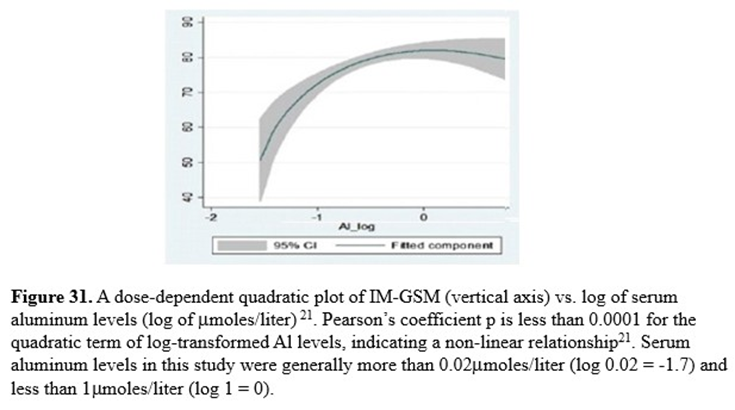
The subject’s blood serum was analyzed for 11 metals including: aluminum, cadmium, cobalt, chromium, copper, mercury, manganese, molybdenum, nickel, lead, and zinc. Only aluminum was found to significantly (p = 0.0001) increase IM-GSM in a non-linear dose-dependent manner as shown in figure 31 plotted as log-transformed aluminum levels versus IM-GSM21.
Details of the 2016 Study: In a similar study the blood serum of 737 apparently healthy 20-60-year-old males and females from the Nellore District of India was analyzed for 10 different metals. Only aluminum levels measured over the range of 0.070 to 0.104mmoles/L were significantly (p = 0.001) positively and non-linearly related to arterial stiffness as measured by PWV24.
These studies have given us tools (i.e., IM-GSM and PWV) to measure endothelial dysfunction and linked aluminum as a causal factor of arteriosclerosis and CAD to endothelial dysfunction. We can conclude that people who do have high levels of aluminum in their blood have increased risk of arterial hardening (AHOR) as expressed in the causal diagram in fig. 32.
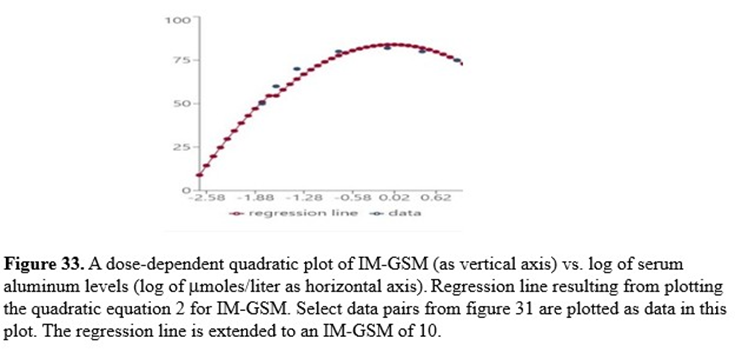
Quadratic regression analysis of data pairs of IM-GSMs and logarithms of the chronic level of aluminum (mmoles/liter) in the blood ([Al]Blood) reveals that IM-GSM can be calculated by the following fitted quadratic equation. This equation fits the data with a coefficient of determination (R2) of 0.94333 very close to 1.0 representing a good fit with the data:
Equation 2. IM-GSM = 84 – 0.156(log [Al]Blood) – 10.5(log [Al]Blood)2
The regression line resulting from plotting the quadratic equation 2 for IM-GSM and selecting data pairs from figure 31 is plotted as an extended plot in figure 33.
In a group of 421 patients 35 to 65 years old those diagnosed with arterial hypertension (high blood pressure) had an IM-GSM greater than 40 and had arterial stiffness as measured by PWV while non-hypertensive patients had an IM-GSM of 30 with an estimated coefficient of variation of 3.5% and no arterial stiffness as measured by PWV20.
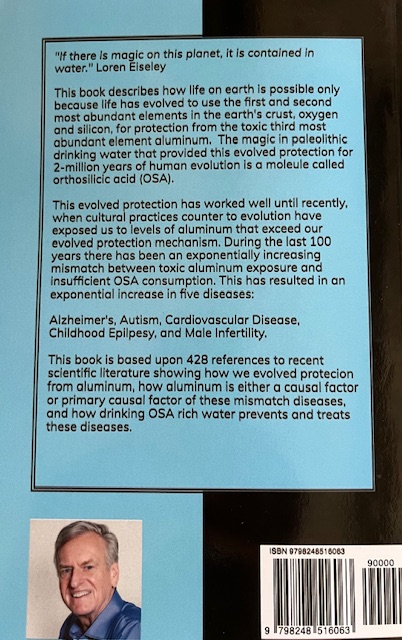
Order the book https://www.amazon.com/Discovering-Magic-Water-Makes-Possible-ebook/dp/B0GPY6GTNG?ref_=ast_author_mpb

In Dennis’ 1st book Prevent Alzheimer’s Autsim and stroke the 2nd Chapter is on Vascular Dementia. Here is an excerpt from the book. The book is available on Amazon.
“Both strokes and ischemic heart disease are caused by a process called atherogenesis (a.k.a. calcification or hardening of the arteries) that results in weakened blood vessels and calcified arteries and heart valves. Factors such as aluminum accumulation, age, smoking, diet, and lipid metabolism have been linked to stroke. Unlike Alzheimer’s, stroke is an old disease recognized over 2400 years ago. Since exposure to increased levels of aluminum has only occurred during the last century, it is not surprising that there are other causes of stroke with a longer history. Figure 2 is a flow diagram of atherogenesis showing the process by which aluminum and other factors cause ischemic and hemorrhagic strokes. The steps of atherogenesis are as follows:
The plaque serves as nucleation sites for calcium and phosphate in the blood to crystallize as a solid on the plaque resulting in atherosclerosis.
Aluminum impacts lipid metabolism by causing low density lipoprotein (LDL), cholesterol, and triglycerides to rise and the level of L-carnitine to fall.
Aluminum accumulation, genetics, vitamin deficiency, chronic moderate alcohol consumption, animal-protein diet, caffeine, and nicotine can all individually cause levels of serum homocysteine to rise.
Elevated levels of homocysteine weaken the ultra-thin smooth inner lining of arteries, called the endothelium194,195.
Particles of LDL penetrate the weakened endothelium.
The LDL in the endothelium becomes oxidized.
White blood cells stream in to digest the oxidized LDL196.
Foam cells form a plaque on the inside wall of the weakened endothelium.”